Monday, April 13, 2015

Hard Hat Fairy Tales - Our Donors Choose Project!

Parents and families, please share this information with anyone that might want to help with this fundraising project!  Our Cannon Elementary 1st grade team is looking for new materials for STEM and engineering connections in all areas.  So I've created a classroom project request at DonorsChoose.org, an award-winning charity.

We're asking for donations of any size to help our kids. If you know anyone who is passionate about education, please pass this along. Your donation will brighten our students' school year, and you'll get photos and thank yous from our class.

Here's my classroom request:

http://www.donorschoose.org/project/hard-hat-fairy-tales/1540271/?rf=email-system-2015-04-teacher_promo_expiring-teacher_2897224&challengeid=20574422/

To have your donation matched dollar for dollar, enter the promo code SPARK on the payment screen. This awesome match offer lasts through April 16.

My students and I greatly appreciate your support.

Saturday, April 4, 2015

Geometry + Coding = Fun Learning


Friday afternoon, during our Create Time, we had a short introduction to the coding app Hopscotch.  This app uses a "drag and drop" format for kids to create their own projects.  We made our cartoon character draw a square together and then I challenged the kids to make another program to draw a different geometric shape.  I gave them some examples of the number of degrees to use for different angles since we don't study that in 1st grade.  The kids had to think about how many sides their shape has so they could program the repeat command to draw that many sides.  They also experimented with different lengths of sides and some fun extras for their character at the end of the shape.  Everyone had a complete project to share at the end of our work time!  Students can share their creations with you on their iPads.  In addition to applying what we are learning about shapes and their attributes, coding gives students practice in logical thinking, sequencing commands, and the STEM design process of testing and improving.


In our 2 dimensional geometry, we have learned several shapes and their most important attributes.  You can help your child practice this vocabulary at home.  Look for examples of these shapes in everyday objects!

Triangles have 3 sides and 3 corners (vertices).  


Rectangles are 4 sided shapes with all square corners.  (We have talked about the terms right angles and 90° angles, but students don't need to know those yet.  We have compared a square corner to the corner on a normal piece of paper.)  Notice that squares belong in the group rectangles because they have 4 square corners.  All squares are rectangles.  And some rectangles are also squares...


A rhombus is a 4 sided shape with 4 equal sides.  Notice that squares are also rhombuses because their sides are the same length.  All squares are rhombuses.  And some rhombuses are also squares...  (We have also talked about the word quadrilateral for any shape with 4 sides and 4 corners, but it isn't something 1st graders have to know yet.)


Students don't need to know that a pentagon is a 5 sided shape yet, but they do need to know that hexagons are shapes with 6 sides and 6 corners.


It is really important that students know the most specific name for a shape, but they also need to know that many shapes can be called more than one name - just like your dog might also be a beagle and it is also your pet and a mammal and an animal...  So a square is also a rectangle and a rhombus and a quadrilateral and 2 dimensional and a closed shape...

Other important vocabulary for 2D geometry in 1st grade includes circle, straight sides, curves, and open or closed shapes.  All the shapes drawn above are closed shapes.  Circles, ovals, and the letter D are also closed.  Open shapes have lines that don't go all the way around like C, L, or S.  You couldn't color in an open shape because you wouldn't know where to stop coloring.

Next week we will also learn about 3D shapes!  


Thursday, April 2, 2015

Nest Challenge

Our current science/engineering project is about nests.  Students have gotten to examine some real birds' nests and look at photos showing many different styles of nests.  We talked about what materials the birds used, how the materials kept the eggs warm and protected, and where the nests were located.  We even looked at some books about nests and found out birds aren't the only creatures that build nests for their eggs.  As we talked about how the birds used the materials in their nests and how they connected the parts, the idea of weaving came up.  So we did some paper weaving next.  Students had the options of cutting straight lines or making more unusual shapes and choosing to use 1 or 2 colors.  They created this great artwork:


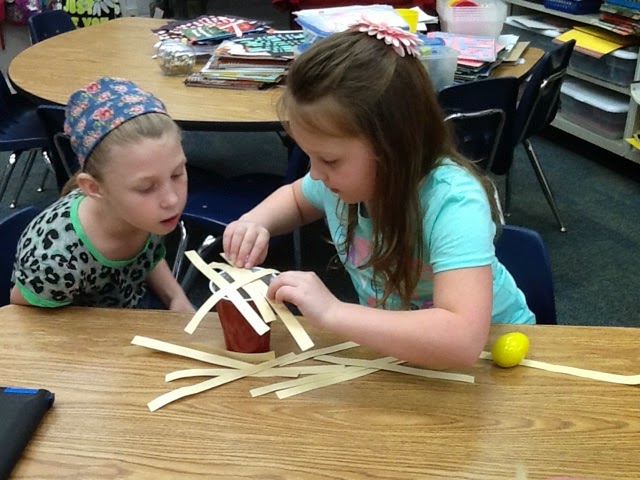
Then we tried a little mini-challenge.  Students worked with a partner.  They had a cup, some paper strips, and an empty plastic egg.  The task was to use the paper strips to create a structure that would keep the nest from falling into the cup.  When they were successful at that task, we made it a little harder.  Since eggs aren't really hollow, I put some rocks inside the eggs to make them heavier.  Students had to be more strategic about how they arranged the strips of paper to hold up the heavier weight.  Then as the final part of the challenge, they tried to weave the strips together so that they would not need as many.  Here are several photos of the hard-working teams!  (Our next steps will be to examine the materials for the big challenge and to construct a nest that can hold several eggs and keep them from falling out even on a windy day!)


Saturday, March 28, 2015

First Grade Excitement

We have had an exciting couple of days in 1st grade! On Thursday we  got a betta fish for our class.  We reviewed the needs of living things and how we would provide for those needs as we got his aquarium set up.  We did a bit of research to learn more about betta fish.  Many names were suggested, and after a vote the winning name was Penny.  Penny is currently enjoying his new home in our class.  He will be one of our references as we learn more about living things in science.


Friday morning in math students enjoyed a math treasure hunt.  They used their iPads to scan QR codes, solved math problems, and found that answer to scan the next QR code.  When they had solved all their math problems, the last QR code led to a fun music video as a reward.  In our next math units we will be learning about geometry and fractions!  More math fun lies ahead.

Then Friday afternoon during our Create Time, we went to the media lab for our first robotics lesson.  Students worked in pairs to follow the directions on the laptops and build a Lego lion.  Then they practiced some coding skills to program it to stand up and lie down.  This was a very popular activity and we will definitely go back for more robotics!  Here is a short video of how it moved and some more photos of hard working engineers:


Monday, March 16, 2015

Math Activity Today

Since we are working on addition and subtraction these days we tried a new activity in class today to practice adding 2 or more addends.  I gave each student 2 playing cards (from 2 - 10, no face cards) and they could use one or both of their cards.  Then I called out a target number to make and the kids found partners whose cards added up to that target number.  Students used strategies like the combinations that make 10 or using the spots on the cards to count on.  Here are some of the successful combinations that were made today!


For the final challenge I asked students to make exactly 20 using exactly 4 cards.  That was tricky, but we had 2 groups find a solution!

Friday, February 20, 2015

Create Time

Here are some hard-working students during our Friday Create Time.  This week we had some very interesting buildings, vehicles, and creatures!


Wednesday, February 11, 2015

1st Grade Science

In science we have begun learning about living and nonliving things.  We have talked about 4 main characteristics of living things:  they have basic needs (like air, water, food), they can move or react to changes, they can make new offspring, and they have a cycle of birth, growth, and death.  The surprising thing for the students (and many adults) is that in science when we use the term living to classify things, we include things that were once living or came from living things (like a log, feather, or dead bug).  Nonliving things don't have all of those characteristics (although they may have some).  Nonliving means things that are not alive and never were.  This led to many interesting discussions about fire (nonliving, but does need air and can grow larger) and the sun (nonliving, but can move) and things like a banana (which counts as a living thing because it came from a banana tree).  We put together some pictures of living and nonliving things and students wrote about them on their blogs.  Ask your child to tell you whether some things around your home would be classified as living or nonliving.

We are starting to do research on animals next.  We brainstormed a list of things we might want to find out about animals today and students chose the one they want to learn more about.  We have everything from dogs and cats to cockroaches and the king cobra!  Soon your child should be able to tell you some new things they are learning as we research.