Showing posts with label reading. Show all posts

Wednesday, May 31, 2017

Summer Learning

This is a revised version of a previous end of the year post:

Parents, the summer slide is not a fun playground activity!  It is the very common summertime loss of several months' worth of academic progress.  Please make sure your child is not a victim of this slide and can keep making progress even over the summer months.  You can find my summer iPad tips and activities here as well as links to Cannon and GCISD reading activities and fun challenges.


Have your child use Istation reading and RAZ-Kids on their iPads this summer.  Istation will present lessons and practice older skills.  Their login is usually first name last initial (iPads are set to remember this) and their password is their first name.  RAZ-Kids passwords are also their first names.  In RAZ-Kids students can listen to and read books on their level and then take a short comprehension quiz.  They can also make a recording for me and I will give them feedback (even in the summer!)  

If your child ended the year reading at a level 18 or above, they are prepared now for 2nd grade.  To be sure they stay prepared, they need to read daily all summer for at least 15-20 minutes.  You can go to the public library and use books in RAZ-Kids on their iPads.  Students at these levels need to work on their fluency and deeper comprehension.  Talk about what they are reading.  Can they tell you the main events of a story?  Can they explain what a character feels or why they do something? Can they make inferences about things the author doesn't state directly? Have them read aloud to you.  They should be reading smoothly so the words are grouped into phrases (not word-by-word) and using expression so it sounds more like talking.  Working on Istation 1 -2 times a week will give them some lessons in new concepts and a variety of kinds of reading.  

If your child ended the year reading below a level 18, they need to continue reading and make progress over the summer.  They need to read daily all summer for at least 15-20 minutes.  They need to continue to work on Istation at least 3 times a week for at least 20 minutes!  (This is the expectation during school in class.)  You can also go to the public library and use books in RAZ-Kids on their iPads.  Students at these levels need to build their automatic knowledge of sight words.  They can use flash cards with you or one of our sight word apps.  They also need to improve their fluency (reading smoothly and in phrases instead of word-by-word).  Rereading books more than once helps practice their fluency.  They can also get on RAZ-Kids and read aloud while they listen to a book.  Talk about what they are reading.  Can they tell the main events of a story in order?   Can they tell how a character feels and why?  Can they predict what might happen next?

In addition to reading, students need to keep up their writing and math skills.  There are some good math ideas on my iPad list.  Leave notes for each other on the fridge.  Starting a 2-way journal between parent and child is another way to make writing meaningful for young children.  Write to your child and have them write back to you.  

Play games with your family that involve words or numbers.  Dominoes builds counting by 5 and addition skills.  Hangman, Scrabble, and many other games are built on spelling concepts. 

Go places and try something new!  Museums, parks, fishing, sports, anything that broadens their experiences and builds their background knowledge and vocabulary. You don't have to spend money!  Go on a nature walk and talk about what you see.  Start a collection of something that interests your child.  Walk around a park and look for all the words on signs that they know.  Make up math stories about things they like to do.  Staple some pages together and let them write and draw about things they do.  If they are begging for a new toy, have them submit a request in writing giving you 3 good reasons.  Read in new or weird places.  Build something together.  Cook something together and talk about all the math involved.  People watch at the mall and read the mall map together.  Take something apart and see how it goes together.  Pick something you are both interested in and learn more about it.

If you have any trouble logging in or using iPad apps for learning this summer, you can reach me through Class Dojo or at my email and I will try to troubleshoot!  I hope you have a wonderful summer of fun and learning and that all our kids are ready for a new year in August!

Thursday, March 2, 2017

Happy Birthday, Dr. Seuss!


We enjoyed some Dr. Seuss stories today and wore our fun hats in honor of his birthday!

Saturday, September 3, 2016

Our Day in Pictures!

In this post I want to let everyone know what a typical day will be like for us in 1st grade.  There will be times our schedule changes due to special events or projects or to share materials with other classes, but this will give you a look into an average day's events.  (These photos were taken over several days during the first days of school.) 

Our school day begins with breakfast, KCAN, and circle time.  In circle time we might share what we did over the weekend, our thoughts about school, problems our class needs to solve, or goals or wishes we have.  After circle time we always share a story that I read to the class.  

Then we will have science and engineering time.  We might be going out to the garden to observe the weather and the season, studying plants and their parts, reading or writing about science or conducting investigations.

In these pictures we are in the science lab observing photos, models, and real objects and trying to find the connection between all the things at one station.  The students found objects that all had to do with birds, sea creatures, bugs, reptiles and mammals.


After science, we usually take a short movement break with dance videos from GoNoodle or other activities and a bathroom and water break for those who need it.  Then it is time for reading.  We may start with a short book or just use a book we have already heard as part of our mini-lesson for the day.  We may be working on strategies to figure out words when they are stuck, things to think about while reading to help them comprehend the book more deeply, reading together to hear rhymes and poems, working on word patterns or more!  Then students will have a chance to do several kinds of reading.  They may read in a group with me or with me individually.  They may read on their own, with a partner, on their iPad with apps like RAZ-Kids or iStation, or do other activities to practice word patterns or sight words.  Reading with me is the time when they will get to work on strategies that are just what they need to make progress to the next level.  Reading on their own gives them a chance to practice those strategies in books that are just right for them.  Partner reading time gives them a chance to read together with a friend and enjoy stories.  They will often pick more challenging books with a partner, especially books I have read to the class, when they can help each other.  Since they are reading aloud with a partner, it also helps them practice their fluency - reading smoothly and with expression.

Here are some partners enjoying books together:


After our reading time, we will often take another short movement break before we start writing.  Writing time also begins with a short mini-lesson about conventions of writing (capitalization and punctuation), choosing ideas to write about, organizing their writing, revising when they have finished, and more.  Then students will have  time to write and make quick illustrations for their stories.  (We will only do full-color, detailed artwork when we are finishing stories to publish.)  Sometimes we will share their writing with the whole class and sometimes in small groups or with partners.  We will also spend some time here working on handwriting and spelling skills.

Writers hard at work:


After writing, we have a break for lunch and recess.  Then it is time for math.  This year we will learn about numbers to 120 (and more), adding and subtracting to solve problems, geometry shapes, fractions, money, and time.  Sometimes we will use manipulatives like blocks or other objects to begin learning a concept hands-on.  At other times we will do work on paper or iPads, drawing pictures or writing equations to show their mathematical thinking.

Our first math unit is on graphs and these pictures show graphs made on the tables as students sorted their pattern shapes by color.  (After this we made graphs using a math app and then put those pictures into another app to label the graphs.  This is what we call app-smashing!)


When math ends the students go to specials classes.  After that we have a block of time at the end of the day that is for a variety of things.  We may use the time to work on big engineering projects or projects for other subjects that need more time.  (Lots of our engineering projects are connected to science concepts, but we sometimes have connections to social studies, math, or language arts.)  We may be working on learning to code, building structures, doing design challenges, building and programming Lego robots, and other STEM related activities.  We might also be working on setting goals for learning or tracking progress on charts for reading, writing, and math.

Here are some of this year's first design challenges.  Build a structure as tall as possible with the materials:


Build a structure where only 1 piece touches the table:


Build a structure that can support the weight of the blocks in the large cup:


Build the tallest structure using 1 piece of paper and NO glue or tape:


The last thing we do every day is to share another read aloud book before students are dismissed.  Starting and ending the day with read aloud time gives us a (kind of) quiet time (there's a surprising amount of conversation during the stories) to share good books and get excited about reading.  We get to share what we think about the books and get to know all kinds of characters in them.  It is a happy way to begin and end our learning time! I hope you enjoyed seeing students at work throughout all parts of our day.

Monday, May 30, 2016

Summer Reading and Learning Fun!

Parents, the summer slide is not a fun playground activity!  It is the very common summertime loss of several months' worth of progress.  Please make sure your child is not a victim of this slide and can keep making progress even over the summer months.  You can find my summer iPad tips and activities here as well as links to Cannon and GCISD reading activities and fun challenges.


Have your child use iStation reading and RAZ-Kids on their iPads this summer.  iStation will present lessons, practice older skills, and give them an assessment the first time they log in each month.  Their login is usually first name last initial (iPads are set to remember this) and their password is the same as the login.  RAZ-Kids passwords are the standard district password (located in their contacts folder).  In RAZ-Kids students can listen to and read books on their level and then take a short comprehension quiz.  They can also make a recording for me and I will give them feedback.  

If your child ended the year reading at a level 18 or above, they are prepared now for 2nd grade.  To be sure they stay prepared, they need to read daily all summer for at least 15-20 minutes.  You can go to the public library and use books in RAZ-Kids on their iPads.  Students at these levels need to work on their fluency and deeper comprehension.  Talk about what they are reading.  Can they tell you the main events of a story?  Can they explain what a character feels or why they do something? Can they make inferences about things the author doesn't state directly? Have them read aloud to you.  They should be reading smoothly so the words are grouped into phrases (not word-by-word) and using expression so it sounds more like talking.  Working on iStation weekly will give them some lessons in new concepts and a variety of kinds of reading.  

If your child ended the year reading below a level 18, they need to continue reading and make progress over the summer.  They need to read daily all summer for at least 15-20 minutes.  They need to continue to work on iStation at least 3 times a week for at least 20 minutes!  (This is the expectation during school in class.)  You can also go to the public library and use books in RAZ-Kids on their iPads.  Students at these levels need to build their automatic knowledge of sight words.  They can use flash cards with you or one of our sight word apps.  They also need to improve their fluency (reading smoothly and in phrases instead of word-by-word).  Rereading books more than once helps practice their fluency.  They can also get on RAZ-Kids and read aloud while they listen to a book.  Talk about what they are reading.  Can they tell the main events of a story in order?   Can they tell how a character feels and why?  Can they predict what might happen next?

In addition to reading, students need to keep up their writing and math skills.  There are many great ideas on my iPad list.  Continuing to post on our class blog is a great way to write and keep in touch with school friends!  Starting a 2-way journal between parent and child is another way to make writing meaningful for young children.  Write to your child and have them write back to you.  

Play games with your family that involve words or numbers.  Dominoes builds counting by 5 and addition skills.  Hangman, Scrabble, and many other games are built on spelling concepts.  

If you have any trouble logging in or using iPad apps for learning this summer, you can reach me at my email and I will try to troubleshoot!  I hope you have a wonderful summer of fun and learning and that all our kids are ready for a new year in August!

Saturday, January 30, 2016

Fairy Tale Engineering

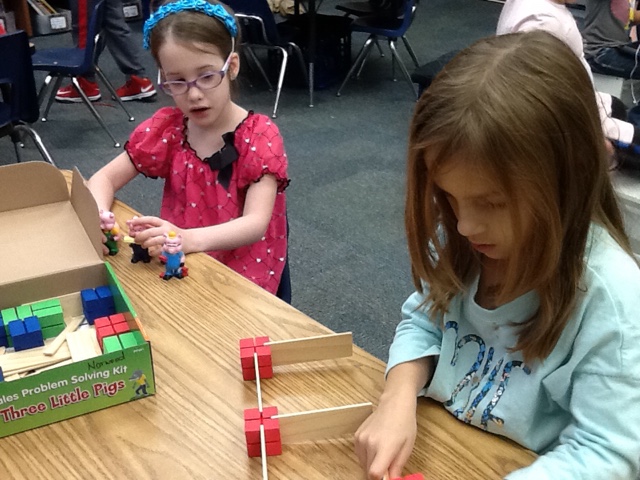
Recently we have been focused on fairy tales during reading and engineering time.  I have read aloud some traditional stories like The Three Little Pigs and students have read and listened to other stories.  We also incorporated some fairy tale building challenges that I got for our class through the Donors Choose program.  With each kit students could practice retelling and acting out the story with the character pieces.  They could also try to design a structure to meet that story's challenge.


Trying to build a house big enough for all three little pigs that the wolf cannot blow down:


Trying to build a bridge that goes over the troll that can hold all three billy goats:


Trying to build a chair that can hold even the biggest of the three bears:


We will be continuing to focus on fairy tales in our next engineering challenge!  You can read more about that on in a future post!


Monday, September 14, 2015

RAZ-Kids Reading!

I want to let everyone know about a tool students have on their iPads which can be used for reading at home and at school!  RAZ-Kids is an app our school has purchased that provides students with a large variety of books at their "just right" reading level.  I have entered all the kids and we have used the app in class a few times now so they should know their way around.  

Students can choose a book to read.  If they want or need extra support they can listen to it first and read along.  Then they should read it on their own.  After that, there is a short, 5 question quiz about the book.  When they take the quiz, they can have the computer read the questions and answer choices and they can go back to the book to reread.  There is also a way for students to record themselves reading and turn the recording in to me.  We will use this feature in class soon!  All this information is available to me so I know how students are using the app and how they are doing on their reading on their own.

This app provides all kind of books for students:  fiction, folk tales, and information books on many topics.  There is truly something for everyone here!  RAZ-Kids is always an option for kids when they are reading at home. 

Monday, April 13, 2015

Hard Hat Fairy Tales - Our Donors Choose Project!

Parents and families, please share this information with anyone that might want to help with this fundraising project!  Our Cannon Elementary 1st grade team is looking for new materials for STEM and engineering connections in all areas.  So I've created a classroom project request at DonorsChoose.org, an award-winning charity.

We're asking for donations of any size to help our kids. If you know anyone who is passionate about education, please pass this along. Your donation will brighten our students' school year, and you'll get photos and thank yous from our class.

Here's my classroom request:

http://www.donorschoose.org/project/hard-hat-fairy-tales/1540271/?rf=email-system-2015-04-teacher_promo_expiring-teacher_2897224&challengeid=20574422/

To have your donation matched dollar for dollar, enter the promo code SPARK on the payment screen. This awesome match offer lasts through April 16.

My students and I greatly appreciate your support.

Thursday, February 5, 2015

100th Day of School

Today was the 100th day of 1st grade and there were special activities happening all day!  This morning classes rotated to all the 1st grade teachers.  In my class we were trying to figure out which container had exactly 100 objects inside.  Students worked with partners to put objects into groups and skip count to find the totals.  They also compared their number to 100 and figured out how many more they would have needed or how many extras they had.  Look at all the different counting strategies and arrangements used:


This afternoon we worked on a 100 book challenge.  Our class tried to read 100 books in one afternoon!  We didn't reach 100 books, but that's because we did a lot of partner reading and enjoyed lots of great stories with friends.  Here are some happy readers with their books: