Sunday, November 6, 2016

Mr. McGregor's Wall

Our most recent engineering challenge was to design a wall to keep a rabbit out of a garden.  We began with the "Imagine" stage of the design process.  I read the class "The Story of Peter Rabbit" and we talked about the characters and events in the literature.  We had a visit at school from "Ruffles" the rabbit so everyone could see a rabbit up close and pet it and get a good look at its fur and claws and strong back legs.  We also talked with a garden expert over the internet and asked lots of questions about gardens, garden pests, and how to keep your garden from being eaten.  All of these experiences added to the students' background knowledge about the topic and helped them be prepared to be successful.

Then came the "Planning" stage of the design process.  We studied the materials that would be available for building and the class worked in groups of about 3 students to design their first plan.

The pictures below show groups in the "Design" stage where they are building their wall according to their first plan and trying to make things work.  That led pretty quickly to the "Improve" stage where students tried to fix what didn't work the way they wanted it to.  At this point of the design process we always get into a loop of designing and testing and improving as long as time, materials, and energy hold out.


Some walls got taller than others and students learned that with limited resources, you must plan carefully.  During our final tests, the robots played the part of rabbits trying to get through the wall.  All groups were at least partially successful and during the "Share" part of the design process, we watched the final tests together and discussed what was strong about each wall and what ideas they still have for further improvements.


This design process (imagine, plan, design, improve, share) is what we use to organize our engineering projects, but really it is applicable to many other areas! In math, writing, and reading we try something out (figuring out a new word, solving a problem, spelling a word) and test it to see if it makes sense with what else we know.  If it doesn't, we go back to try to improve our solution.  As we work through many other design projects this year, students will begin to talk about these stages very naturally and incorporate the "design thinking" into many things they do.  Look for examples in daily life of how you use this cycle!

Tuesday, October 25, 2016

Math? No Problem!

We are currently hard at work learning about math problems including "story problems".  We began this unit with a challenging problem that said, "There are 10 toy cars in all.  Adrian, Bob, and Carla each have a different number of cars." Then I asked the class to find all the different ways they could make that work.  They went busily to work and most found about half of the combinations in one class period.  (There are over 20 in all.)  Here are some happy math explorers:


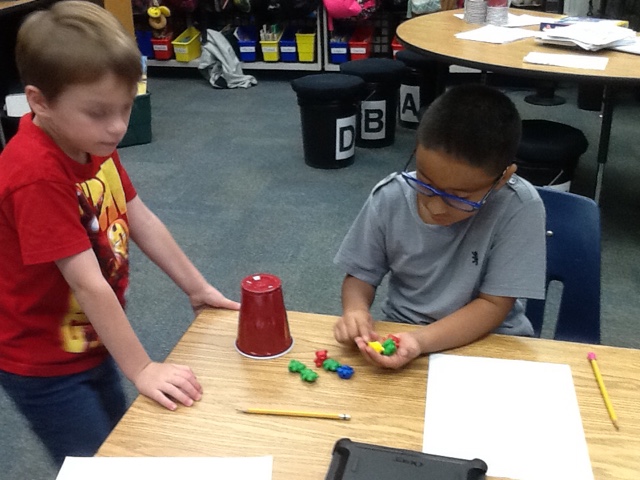
Another thing we are working on in this unit is modeling math equations.  We played "Bears in a Cave" one day.  Students took turns hiding some of their 10 bears in the "cave" and their partners had to figure out how many bears were under the cup and write the number sentence (as an addition problem).


Another thing we have been working on in math is what the equals sign means.  We have talked about different problems we can write such as 4 = 4 or 6 = 2 + 4 or 3 + 5 = 6 + 2.  In all these examples the equals sign shows us that both sides of the equation balance and are equal to the same amount.  We actually used blocks and the balance scales from the science lab to act out these equations! 

We are still working on modeling some subtraction problems and some problems where we compare two amounts.  (Example:  There are 4 ducks at the pond and 7 geese.  How many more geese are there than ducks?)  Students often model these problems by matching up both sides until they run out of something.  In this case, you can match 4 ducks with 4 of the geese, but then you have 3 extra geese without partners.  Those are the 3 more that answer the math question.  We also start to look at problems like that as either a missing addend problem (4 + ___ = 7) or a subtraction problem (7 - 4 = __).

Students need to see how math like this is all around us in our everyday life.  One way to help kids with this at home is just to make up problems about whatever you are doing: 

We have 4 forks and 4 spoons on the table.  How much silverware in all?

There are some carrots in a bowl.  Mom eats 2 and then there are 5 carrots left.  How many carrots were there to start with?

Dad ate 4 pieces of pizza and I ate 2 pieces.  How many more pieces did Dad eat?  How many pieces did we eat in all?  If the pizza had 8 slices to start with, how many are left for Mom?

There were 9 toy cars in my set, but now I only find 5.  How many cars are lost?

When doing problems like this, don't just figure out the answer!  Also talk about what the number sentence would be for that problem.  And then turn it around and give the child a number sentence like 6 - 2 = ___ and have them make up a story problem for that equation!

We are also working on learning the math combinations that add up to 10 (1 + 9, 2 + 8, 3 + 7, etc.) so we know them "in a snap".  Students have an app called "Make 10+" that they can use to practice these combinations. 

This unit includes math problems up to 10 and will end next week, but we will come back to this kind of problems solving later in the year with a unit going up to 20. 


Thursday, September 15, 2016

Dot Day

Today we celebrated Dot Day with many different activities. 


First we read the book The Dot by Peter Reynolds and discussed the story and the idea of "making your mark" on the world.  This was kind of a hard idea for the class to understand and we will continue to talk about ways people make their mark as we move on.  We tried making colorful marker dots on coffee filters and dipping them in water.  This made some wavy art and we could see some of the colors that make up other colors as the water made the ink run.  

In writing time, we made dot art by turning several large and small dots into a picture and then started stories about them.


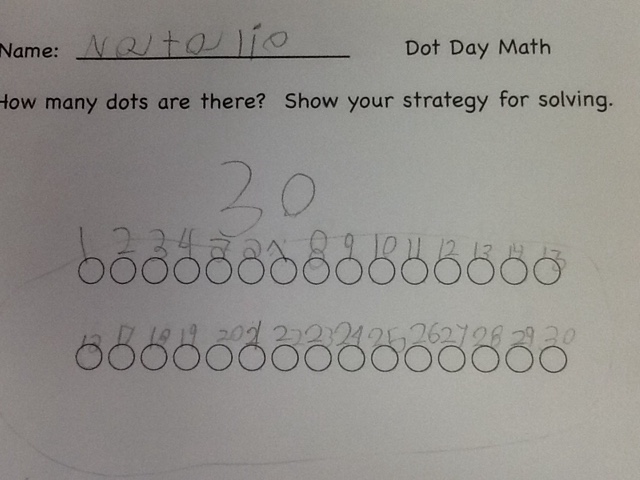
During math we counted a collection of dots to practice our number skills.  Some students counted by ones and wrote all the numbers while others grouped the dots and skip counted.


Near the end of the day, we did a different kind of drawing activity, in which students used their creativity to turn the dots into as many different kinds of things as they could think of!  We had lots of ideas:


Of course we also dressed in dots today, but since I forgot to take any photos, you will just have to use your imagination to picture how cute everyone looked! 


Crime Scene Investigators in Science

We have been learning about properties of matter in science.  First we looked at a collection of objects and brainstormed different ways to describe them such as size, weight, color, material, shape, and texture.  Then students chose an object to draw and label in their science notebook.  Here are a few examples:


Then we put our skills to the test as crime scene investigators.  I presented the following scenario to the class:  A toy store was broken into in Grapevine recently and the method used was a ball thrown through the window.  Since it was a toy store, there were lots of other balls found inside.  We have been asked by the police department to confirm which of the balls found was the culprit.  We were given 2 clues to work with.  Clue 1 said that the ball used to break the window was smaller than an apple.  Clue 2 said that the ball used was the heaviest of the balls.  

First students worked with their teams to put the balls in order by size and eliminate the ones that could not be the culprit because of their size.  Then students used a balance scale to compare the balls by weight and narrow it down to the correct object used in the break-in.  Here are some students hard at work to solve this crime! 
 
When the teams were done, they recorded their results in their science notebooks like this:


Then we opened the evidence box to find that the small silver ball was the one used in the crime - just as our class of detectives had concluded!